- New Classical Guitar
- Posts
- Issue 41
Issue 41
In this issue: Rosie Bennet in our YouTube find, album of the week by Daniela Rossi, sheet music in our morning-routine with Leon Albert, interview with Thomas Fellow and the feel-good tune of the week with Fernanda Tarrech
Hey!
We have previously addressed the weaknesses in the repertoire with regard to female composers, and on the occasion of International Women's Day a few days ago, we would like to keep this issue in mind today and in the future. We are delighted to see how much is happening in this area now. We are also extremely pleased to have come across an album that will stay at the front of our shelf for a good while – and to see that Leon is doing his thing. That’s what we all should do! The centerpiece of today's edition is undoubtedly the interview with Thomas Fellow. Music knows no boundaries, so it was particularly exciting to gain an insight into his world of composition and thoughts!
Enjoy reading,
Stefan and Willi
YOUTUBE FIND OF THE WEEK
with Rosie Bennet
Last Sunday was International Women's Day (March 8). This video fits the occasion in a very calm but all the more beautiful way: Rosie Bennet plays her guitar version of Prélude, Op. 10 by French composer Mel Bonis. As we know, composing was not considered an appropriate pursuit for women in many bourgeois contexts, and female authorship was often taken less seriously or simply thwarted. Mel Bonis therefore used the androgynous name “Mel” early on so as not to be pigeonholed immediately on the title page. And it wasn’t just her compository work that was impacted by social expectations: when a relationship with a singer became public, her family even withdrew her from the conservatory for a time – a pretty clear indication of how narrow the boundaries were.
Rosie Bennet's arrangement doesn't feel like a mere “transcription,” but rather like a genuine repertoire update. And musically, you can easily hear why she thinks we should all have Mel Bonis on our radar.
ALBUM OF THE WEEK
with Daniela Rossi

Today's album is dedicated to one of the most innovative contemporary composers and guitarists – Dušan Bogdanović. He himself describes the album as a “multidimensional diary” of his works from 1977 to 2024.
From the Balkan folk influences of the early “Sonata No. 1” to his middle creative phase, which was influenced by jazz and world music, to the emotional and spiritual reconciliation of joy and sorrow in “Lux et umbra,” a work dedicated to guitarist Daniela Rossi.
Which brings us to the main protagonist of the album: Daniela Rossi. With her interpretation of these consistently (very) demanding pieces, she creates her own musical arc, which we were only too happy to follow. Her fundamentally energetic playing, combined with a homogeneous sound aesthetic and said beautiful, musically comprehensible arcs, provides just the right mix for us to recommend this Bogdanovic collection to you with a clear conscience.
Specific recommendations: “Guitar Sonatina ‘Homage to J. Haydn’” and the aforementioned “Lux et umbra.”
This record will remain at the front of our shelf!
Enjoy!
MORNING-ROUTINE
A coffee with Leon Albert

Hi Leon, what’s the routine for this week?
Don't let yourself be swayed and pull it through.
INTERVIEW
“I am convinced that the music we listen to most intensely and enjoy most is ultimately the music that shapes us the most”
How you develop your personal composition style
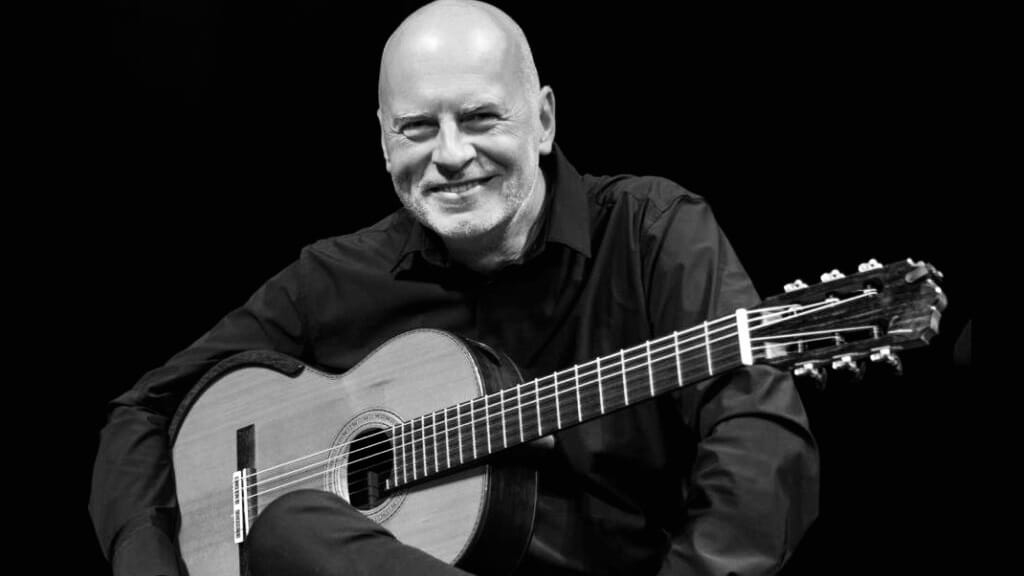
with Thomas Fellow
Thomas Fellow is considered the driving force behind breaking down the clear distinction between classical guitar and styles such as world music and jazz. After a remarkable career as a young classical guitarist, he began to transfer elements such as sound aesthetics and playing techniques from jazz and world music to the classical guitar and to form his own style, which he has been teaching to young guitarists for over 25 years in one of the first degree programs of its kind in Dresden, Germany. Countless compositions for different levels of difficulty testify to his high output of creativity and craftsmanship.
Thomas recently released Vol. 7 of his Fellow Guitar Music Collection entitled Fin de Siècle. It includes solo pieces dedicated to a close circle of guitarists such as Pavel Steidl, Zoran Dukic, Valeria Galimova, and others.
For those of you who want to put some real effort into learning a new piece, we have linked this book below.
For anyone who wants to familiarize themselves with the world of Thomas Fellow's music, we recommend Fingerfood Light.
And for those who are looking for pieces for their students that are outside the box of conventional literature and simply sound cool, we have also linked Children's Corner.
But now let's get to the interview with Thomas. Among other things, we were interested in how he developed his own style, how he approaches composing, and whether he has certain composers as role models.
Hi Thomas! How did you develop your personal compositional style? To what extent did you consciously develop it?
I am convinced that the music we listen to most intensely and enjoy most is ultimately the music that shapes us the most. It is almost impossible to control the type of music we are drawn to. And even my initial ideas are very rarely preconceived or limited. However, everything that lies between an interest in a style or a sound world and composing is a truly intense and conscious process, namely a deeper engagement with the respective stylistic elements.
When you compose for solo guitar, what do you focus on first: the melody, the accompaniment, and its rhythmic character? Or a larger (sound) picture that does not initially involve separating these two levels?
I would say that first and foremost, I have a characteristic in mind, comparable to a character in a novel. This then includes all the elements that shape this initial idea and underlying mood. This also provides a basis for musical developments and contrasts. It is perhaps interesting to note in this context that after just a few bars, I almost always have the title for the piece in my head and can estimate fairly accurately how far this idea will take me (i.e., how long the piece will be in the end). Then I write quite quickly and often very fluidly. At the very end, and with a little distance, I usually make minor corrections and adjustments.
Do you have a composer who serves as a role model, inspires you, or whom you even analyze in order to better understand the respective compositional structure?
There are some composers who inspire me beyond measure, and I analyze almost everything I listen to intensively in one way or another. In many respects, I am particularly influenced by late Romantic and Impressionist music, i.e., concert music by Mahler, Strauss, Rachmaninoff, Stravinsky, and so on. But this is only one side of the coin. Jazz musicians such as (and above all) Pat Metheny, film music composers such as John Williams, and songwriters such as Joni Mitchell have had an equally formative influence on me. In this way, you can develop a penchant for melodies by listening to good pop songs, discover harmonic richness through late Romantic music or jazz, and establish a sense of form by analyzing Beethoven.
Another topic: In your opinion, what does an aspiring guitarist need to bring to the table today in order to meet the demands of the classical guitar world and, above all, to find their place in it and succeed?
First and foremost, a professional musician needs to have a calling, i.e., a deep interest and the ability to devote themselves fully to their craft. It's not a good profession for those who only give it half their energy. And then I recommend trying out lots of different constellations and styles with great curiosity and openness, always searching for the soundscape that best and most authentically represents you and on which you can ideally leave your own mark.
Imagine you could have one sentence printed on a poster to be put up in huge numbers at all the (classical) music festivals in the world. What sentence would that be?
Can I choose two? “Music knows no boundaries!” and “Be different – be you!”
Find the recommended sheet music from Thomas Fellow sorted by level of difficulty here:
FEEL-GOOD TUNE OF THE WEEK
with Fernanda Tarrech
Whether it’s between rehearsals and lessons, after practicing, before a concert, or whenever you need it: put on your headphones, take a break from the noise, and feel good.
Our feel-good tune of the week!
OUTRO
Thank you for reading! Please send any suggestions or comments directly in response to this newsletter. New music discoveries – including from artists we wrote about in today's issue – can be found, as always, in our Spotify playlist for the newsletter, which we've linked below.
Be kind to each other.
Stay tuned!
Stefan & Willi
supported by


New Classical Guitar is a newsletter by Willi Leinen and Stefan Degel from TMBM. You can find our music and more information about our journey at http://t-m-b-m.com/.
On Spotify, we curate a playlist with our favorite pieces. Feel free to follow our New Classical Guitar Playlist at https://open.spotify.com/playlist/3ZwxJRAsW9Zs2JiS2eLy6a?si=9b2a737f01c043a4 and recommend new additions.